
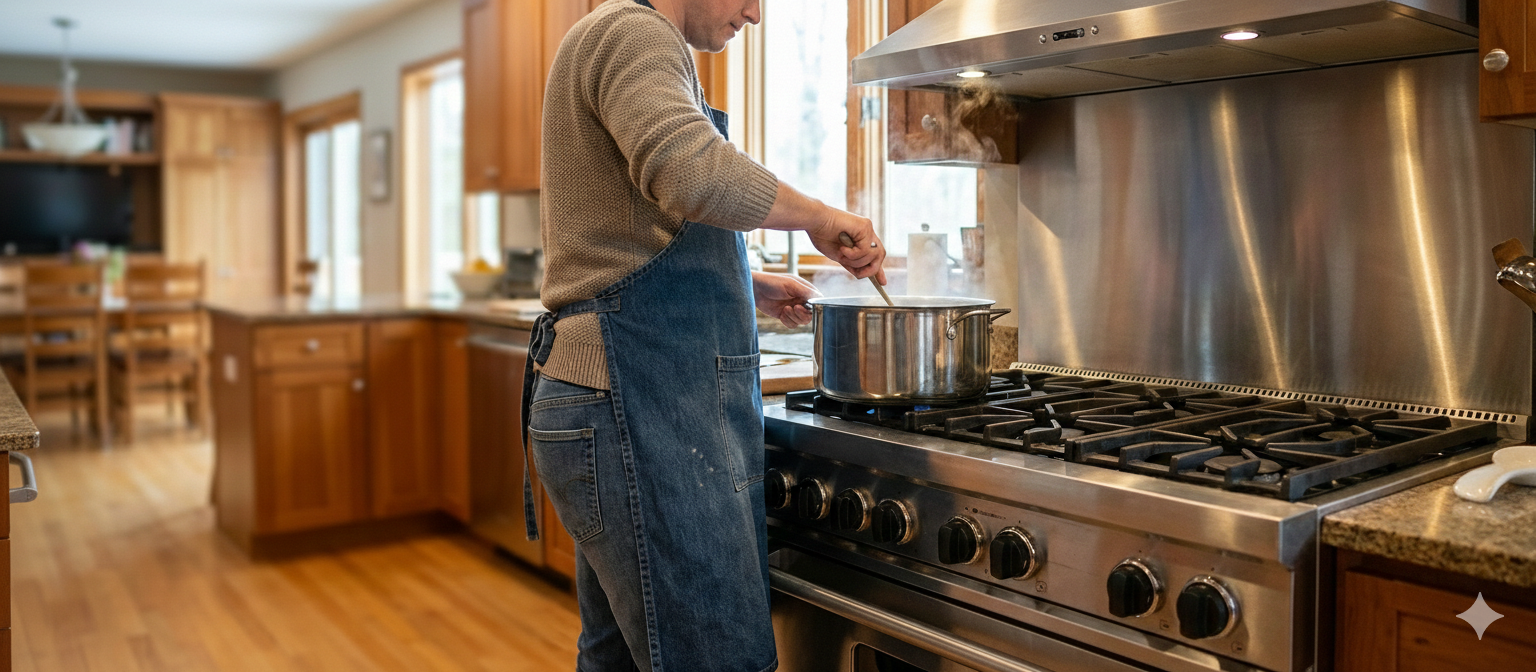
Gas stoves emit nitrogen dioxide, benzene, and carbon monoxide linked to asthma and cancer. A ducted range hood venting outdoors is the most effective protection. Hoods over 400 CFM typically require a makeup air system to prevent backdrafting. Learn how to size, install, and optimize your kitchen ventilation.
Gas Stove Fumes and Your Health: How a Vent Hood Keeps Your Kitchen Air Safe
TL;DR
Gas stoves release nitrogen dioxide, carbon monoxide, benzene, and formaldehyde into your home every time you cook - and even when they're turned off. These pollutants are linked to childhood asthma, respiratory disease, and cancer. A properly installed range hood that vents to the outside is the single most effective way to reduce your exposure while still cooking with gas. If your hood exhausts more than 400 CFM, most building codes require a makeup air system to replace the air being pulled out and prevent dangerous backdrafting.
The Short Answer: Are Gas Stove Fumes Dangerous?
Yes - and the risk is greater than most people realize. Decades of research have established that gas stoves produce indoor air pollution that can exceed outdoor safety limits set by the EPA and World Health Organization within just minutes of cooking. The primary culprits are nitrogen dioxide (NO2), benzene, carbon monoxide (CO), and fine particulate matter (PM2.5), all of which are byproducts of burning natural gas or propane. Children, older adults, and anyone with respiratory conditions face the highest risk. The good news is that you don't necessarily need to replace your stove to protect your family. A quality range hood that vents directly to the outside - properly sized and actually turned on - can dramatically reduce your exposure. Below, we'll break down exactly what's in those fumes, why they matter, and how to set up ventilation that actually works.
What Gas Stoves Actually Release Into Your Home
When natural gas or propane ignites on your stovetop, the combustion process creates several harmful byproducts that mix directly into your kitchen air. Unlike a furnace or water heater, which are typically isolated in a utility room or basement, your gas stove sits right where you live, cook, and eat.
Nitrogen Dioxide (NO2)
Nitrogen dioxide is the pollutant that has received the most attention in recent research. A landmark 2025 study published in PNAS Nexus by Stanford University researchers found that gas stoves are the primary source of indoor NO2 in American homes, responsible for more than half of some households' total exposure. The study's senior author, environmental scientist Rob Jackson, noted that people with gas stoves often breathe as much NO2 indoors from their stove as they do from all outdoor sources combined. NO2 irritates the airways and is strongly linked to asthma - particularly in children. A widely cited analysis estimates that roughly 13% of childhood asthma cases in the United States are attributable to gas stove use. Harvard researchers have also connected NO2 exposure to chronic obstructive pulmonary disease (COPD), lung cancer, preterm birth, and diabetes.
Benzene
Benzene is a known human carcinogen linked to leukemia and other blood cancers. Research from Stanford and PSE Healthy Energy found that cooking with gas can raise indoor benzene levels above what you'd encounter from secondhand cigarette smoke. A 2025 study in the Journal of Hazardous Materials found that children's incremental lifetime cancer risk from gas stove benzene exposure was nearly twice that of adults, and in homes without ventilation, children's risk was up to 16 times the WHO's recommended safe threshold. Critically, benzene doesn't stay in the kitchen - it drifts into bedrooms and living spaces, extending exposure well beyond cooking time.
Carbon Monoxide and Other Pollutants
Gas stoves also produce carbon monoxide, an odorless, poisonous gas that can cause headaches, confusion, and in severe cases, loss of consciousness or death. The risk of CO buildup increases significantly if the stove is improperly installed or not ventilated. Additionally, gas stoves emit formaldehyde (a respiratory irritant and carcinogen), fine particulate matter (PM2.5), and volatile organic compounds (VOCs). Stanford researchers found that gas stoves leak methane even when turned off, with those leaks accounting for roughly 76% of a stove's total methane emissions.
Why a Vent Hood Is Your Best Line of Defense
If replacing your gas stove isn't an option right now, proper ventilation is the most impactful step you can take. But not all range hoods are created equal, and there's a meaningful difference between the types available.
Ducted vs. Ductless: It's Not Even Close
A ducted (or vented) range hood connects to ductwork that carries pollutants completely out of your home through an exterior wall or roof. A ductless (recirculating) range hood pulls air through a filter and pushes it right back into your kitchen. For gas stove fumes, the distinction matters enormously. Ductless hoods can catch some grease and odors, but they do not remove combustion gases like NO2, CO, or benzene. Harvard Health and the EPA both recommend exhaust fans that move air to the outdoors for gas stove ventilation. If you're relying on a ductless hood over a gas stove, you're getting almost no protection from the pollutants that matter most.
Capture Efficiency Matters More Than Raw CFM
Capture efficiency (CE) measures what percentage of pollutants your hood actually catches before they escape into the room. A hood rated at 600 CFM that's mounted too high, too narrow, or poorly designed may capture less pollution than a well-designed 300 CFM hood mounted at the correct height. Research from the Reducing Outdoor Contaminants in Indoor Spaces (ROCIS) initiative suggests that 200 to 350 CFM is the ideal range for a typical home, provided the hood is properly sized and positioned. Key factors that affect capture efficiency include the hood's depth and width relative to your cooktop, the mounting height (typically 30 to 36 inches above the cooking surface), whether you're using front or back burners, and the overall design of the hood canopy.
Sizing Your Range Hood Correctly
For gas stoves, the most common sizing guideline is 1 CFM for every 100 BTUs of total burner output. If your burners total 60,000 BTUs, you'd want at least 600 CFM of capacity. For electric stoves, the formula is simpler: 100 CFM per linear foot of cooktop width, meaning a 30-inch cooktop needs about 250 CFM. You should also factor in your kitchen's volume. Multiply length × width × height in feet, then divide by 4 to get a baseline CFM figure. Compare that to your BTU-based calculation and use whichever number is higher. When in doubt, size up - you can always run a larger hood on a lower speed setting for quieter, more comfortable operation.
The Makeup Air Problem (And How to Solve It)
Here's something many homeowners don't think about until it becomes a problem: every cubic foot of air your range hood pushes outside has to be replaced by air coming in from somewhere. If your hood is powerful enough, it can create negative pressure inside your home - and that's where things get potentially dangerous.
What Is Makeup Air?
Makeup air is simply the replacement air that enters your home to compensate for the air being exhausted by your range hood. In older, drafty houses, air leaks naturally through gaps around windows, doors, and framing, which often provides enough passive replacement. But in modern, energy-efficient homes with tight building envelopes, a powerful range hood can suck the house into negative pressure surprisingly fast. This creates several problems. Backdrafting is the most serious - negative pressure can pull exhaust gases from your furnace, water heater, or fireplace back down through their flues and into your living space, flooding your home with carbon monoxide. Negative pressure can also make doors difficult to open, cause whistling sounds around windows, and reduce the efficiency of your HVAC system.
When Building Codes Require Makeup Air
Under the International Residential Code (IRC Section M1503.4), any exhaust system capable of moving more than 400 CFM requires a mechanical or passive makeup air system when the home contains gas-fired, liquid-fueled, or solid-fuel-burning appliances that are not direct-vent or mechanically drafted. In practical terms, this means that if you have a gas stove, gas furnace, gas water heater, or wood-burning fireplace - and your range hood exceeds 400 CFM - you almost certainly need a makeup air system. Some states and municipalities have adopted even stricter requirements, so checking with your local building department is always a good idea before installation.
How Makeup Air Systems Work
There are two main approaches to providing makeup air. Passive systems use a motorized damper installed in a dedicated duct that opens automatically when the range hood turns on. Air enters from outside through the duct under natural pressure, driven by the negative pressure the hood creates. These are simpler and less expensive but depend on the pressure differential to function and may not keep pace with very high CFM hoods. Active (or powered) systems add an inline fan to the makeup air duct, actively drawing fresh air into the home at a rate calibrated to match the range hood's exhaust. Brands like Fantech offer makeup air units (the MUAS series) designed to maintain neutral, slightly positive, or slightly negative pressure depending on the installation. Active systems are more reliable and better suited for hoods above 600 CFM or homes with very tight construction. In either case, the makeup air duct should have a damper that closes when the hood isn't running to prevent energy loss. Some systems include filtration and tempering (heating or cooling the incoming air) so you're not blasting cold winter air directly into your kitchen.
Ducted vs. Ductless Range Hoods: A Quick Comparison
When shopping for a range hood to use with a gas stove, the choice between ducted and ductless comes down to effectiveness versus installation convenience.
Removes combustion gases (NO2, CO, benzene): Ducted hoods vent these pollutants completely outside. Ductless hoods cannot remove gases - they only filter particles and some grease.
Reduces moisture and heat: Ducted hoods excel here, removing steam and heat from the kitchen. Ductless hoods recirculate warm, moist air back into the room.
Installation complexity: Ductless hoods are easier to install since they require no exterior ductwork. Ducted hoods need a clear path through walls or the roof, which may require professional installation.
Ongoing maintenance: Ductless hoods require frequent charcoal filter replacements to remain effective. Ducted hoods need periodic cleaning of metal mesh filters, which are usually dishwasher-safe.
Bottom line: For gas stoves, a ducted hood venting to the outside is the only option that meaningfully reduces health-relevant pollutants. A ductless hood is better than nothing for cooking odors, but it won't protect you from combustion byproducts.
Choosing the Right Setup for Your Kitchen
Choose a ducted range hood rated at 250-400 CFM if you have a standard residential gas range (30 inches, 40,000-60,000 BTUs), your kitchen is average-sized, and you want effective ventilation without the complexity of a makeup air system.
Choose a ducted range hood rated at 600+ CFM if you have a commercial-style gas range with high BTU output, you do heavy or frequent cooking such as wok cooking or deep frying, or your kitchen is large or has an open floor plan. Remember that most codes require makeup air above 400 CFM if you have any non-direct-vent combustion appliances.
Choose a ductless range hood only if exterior ducting is truly impossible (such as in some apartments or condos with interior walls) and you cannot relocate the stove. Pair it with open windows and consider a portable air purifier as a supplement.
Consider switching to induction if you're planning a kitchen renovation, have family members with asthma or respiratory issues, or want to eliminate combustion pollutants entirely. Modern induction cooktops heat faster than gas, offer precise temperature control, and produce no combustion byproducts at all.
Key Takeaways
-
Gas stoves emit nitrogen dioxide, benzene, carbon monoxide, formaldehyde, and particulate matter - pollutants linked to asthma, cancer, and respiratory disease - every time you cook, and they leak methane even when turned off.
-
A 2025 Stanford study found that gas stoves are the largest source of indoor NO2 for many Americans, sometimes exceeding the pollution exposure from all outdoor sources combined.
-
A ducted range hood that vents to the outside is the most effective way to reduce exposure to gas stove pollutants. Ductless hoods do not remove combustion gases.
-
Size your hood at 1 CFM per 100 BTUs for gas stoves, and always choose a model that covers the full width of your cooktop, mounted 30-36 inches above the burners.
-
If your range hood exceeds 400 CFM and your home has non-direct-vent combustion appliances, building codes typically require a makeup air system to prevent backdrafting and negative pressure.
-
Makeup air can be supplied passively through a dampered duct or actively with an inline fan system. Active systems are more reliable for high-CFM hoods and tightly sealed homes.
-
Turn your range hood on 10-15 minutes before you start cooking and leave it running for the same amount of time after you finish to maximize pollutant removal.
When it comes to protecting your family's health, ventilation is not optional - it's essential. Whether you upgrade your range hood, install a makeup air system, or start planning a switch to electric, every step toward cleaner indoor air is a step worth taking.
Want to catch appliance problems early?
Get The Appliance Survival Kit — a simple system to spot issues before they become emergencies.
Learn More — $27