
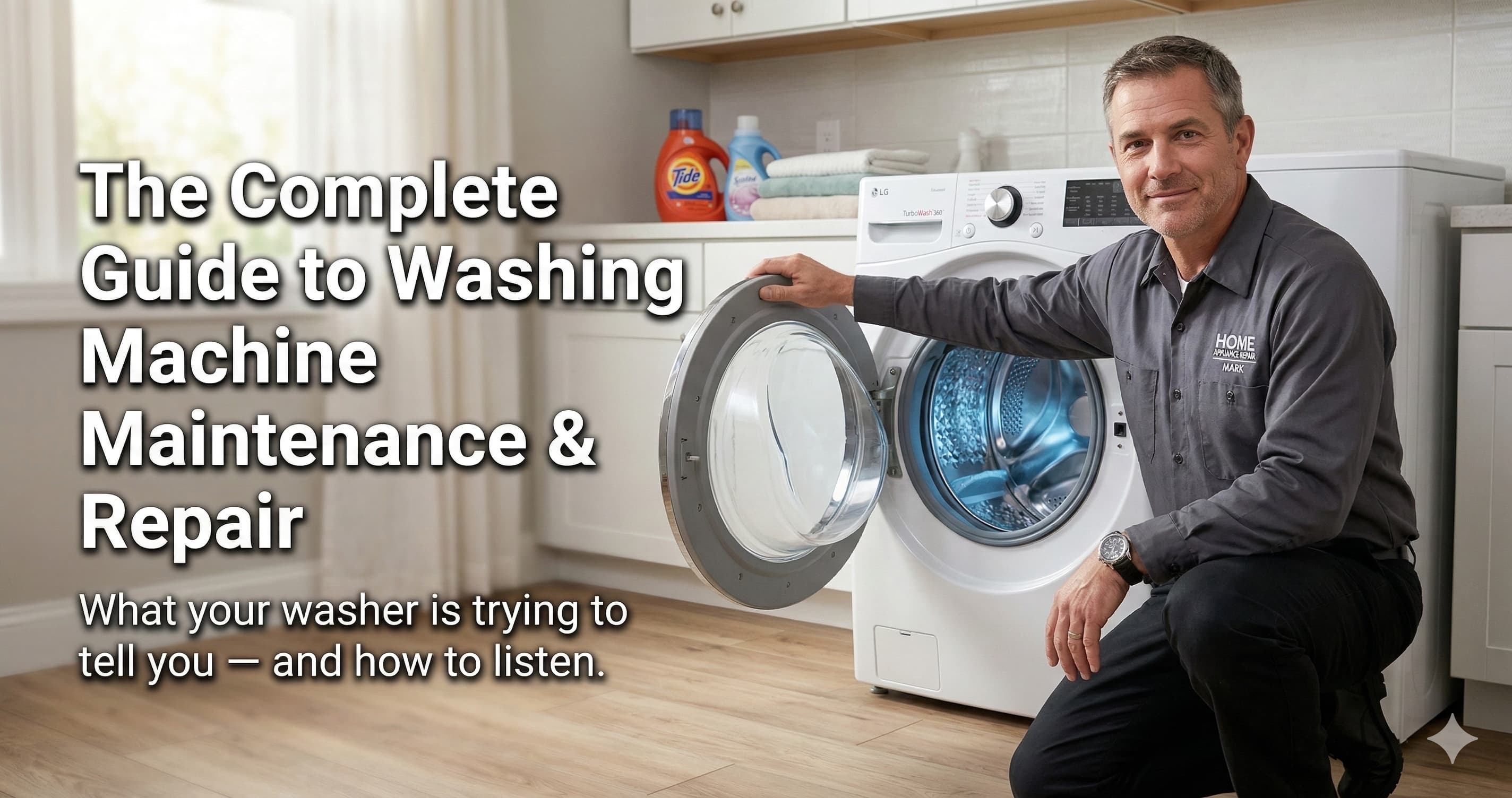
A complete guide to washing machine maintenance for homeowners. Covers inlet hose risk, front-load mold prevention, hard water damage, drain problems, vibration and leveling, error codes, HE detergent habits, and when to repair vs. replace - with links to in-depth cluster posts throughout.
The Complete Guide to Washing Machine Maintenance & Repair
TL;DR
Washing machines last 10-14 years on average - but most failures are predictable and preventable. The highest-stakes risk is a rubber inlet hose that can flood your home without warning. Beyond that, front-load mold, hard water buildup, drain clogs, and vibration issues are the most common problems homeowners face. This guide walks through all of it: why machines fail, what to watch for, and how to keep yours running well.
The Short Answer: What Does It Actually Take to Maintain a Washing Machine?
Washing machine maintenance comes down to a handful of consistent habits: inspect and replace your inlet hoses before they fail, clean the drum and door gasket monthly on front-loaders, use the right amount of HE detergent, keep the machine level, and clean the drain pump filter every three months. Most washing machine problems - mold, flooding, slow drains, excessive vibration - are preventable with basic attention. The deeper you get into repair territory, the more it depends on machine type, age, and the specific failure. This guide covers the full picture.
Why Washing Machines Fail
In more than two decades of appliance service work, I've found that washing machine failures almost always follow one of a few predictable patterns. The machine that "just stopped working" was usually showing signs for months. The flood that came out of nowhere had a hose that hadn't been looked at in years. Understanding why these machines fail is the first step toward making sure yours doesn't.
Wear and Tear
Drum bearings, door seals, pump impellers, and motor components all degrade over time. Front-loaders and top-loaders age differently - front-loaders tend to have more maintenance demands and more specific failure patterns, while traditional top-loaders are more forgiving but harder on fabrics. The age of your machine changes the math on every decision you make about it, from how urgently to address a warning sign to whether a repair is worth pursuing.
Maintenance Neglect
This is the category that accounts for most of what I see in the field. Detergent residue builds up inside the drum and hoses over years of use. Drain pump filters go uncleaned for the life of the machine. Inlet hoses still running on their original rubber from the day they were installed. None of these feel urgent - until one of them causes a problem that is.
Environmental and Usage Factors
Hard water is a quiet, long-term threat that most homeowners in affected areas don't think about until something fails. Mineral deposits build up on inlet valves, inside hoses, and on internal surfaces, gradually reducing flow and efficiency. Overloading the drum strains the motor and suspension components. Using the wrong detergent - or the right detergent in the wrong quantity - creates residue buildup that feeds mold and triggers error codes.
Installation Issues
A surprising number of problems trace back to how the machine was set up. A unit that isn't level will vibrate excessively and wear through its suspension components faster than it should. A drain hose installed at the wrong height can siphon water back into the drum. Inlet hoses that were never upgraded from rubber originals are one of the highest-probability failure points in any laundry room.
The Inlet Hose Problem Most Homeowners Don't Know About
If there is one thing in this guide that changes what you do this week, I hope it's this section.
Your washing machine is connected to your home's water supply by two rubber hoses - one for hot, one for cold. They run from the valves on the wall to the back of the machine, carrying water under constant pressure every single day. Most homeowners have never looked at them. They were installed when the machine was delivered and have been sitting there ever since.
The problem is that rubber degrades from the inside out. You can't see it happening. The hose looks fine from the outside - no cracking, no obvious wear - and then one day it doesn't. When a rubber washing machine hose fails, it doesn't develop a slow drip. It releases water at full pressure.
The water damage that follows - flooring, subfloor, cabinetry, drywall, mold remediation - routinely runs $10,000 to $30,000 or more. And the hose that caused it had been quietly degrading for years before anyone noticed.
The $20 fix that prevents this is a set of braided stainless steel hoses. They cost $15-$30 for a pair, take about 15 minutes to replace, and are far more resistant to the kind of pressure failure that causes floods. If your machine is still running on rubber hoses - especially if you don't know when they were last replaced - this is the highest-ROI maintenance task available to you.
When you do inspect your hoses, look for bulging near the fittings, soft spots, cracking, mineral deposits around the connections, and any moisture or rust on the wall valves. If you find any of those, don't wait.
If you want to check your water connections as part of a complete machine inspection, the Survival Kit walks you through exactly what to look at and what the warning signs mean.
Early Warning Signs
Washing machines almost always give you signals before they fail. The challenge is knowing which signals matter. Here's what to watch and listen for.
Sounds That Have Changed
Every washing machine has its own normal sound profile - the hum of the motor, the swish of water, the spin winding up to speed. What you're listening for are changes.
Banging or thumping during spin often points to load distribution, but it can also indicate worn suspension components if it persists after rebalancing. Grinding or rumbling at high spin speeds - especially on a front-loader - can suggest bearing wear. Buzzing or humming that's louder than usual during the drain phase may point to a pump working harder than it should. A squealing sound during agitation or spin is worth noting and tracking.
The pattern matters more than the sound itself. A noise that shows up once may be nothing. A noise that returns every cycle, or gets louder over time, is your machine telling you something has changed.
Performance Shifts
Clothes coming out wetter than usual after spin. Cycles taking noticeably longer to complete. The machine stopping mid-cycle and needing to be restarted. Laundry that smells musty even fresh out of the wash - this one in particular is a sign worth taking seriously, because it usually means mold has established itself somewhere in the machine.
These aren't dramatic failures. They're the gradual kind that are easy to dismiss individually. Patterns are the signal.
Leaks and Moisture
Water on the floor during or after a cycle. Moisture or rust around the hose fittings on the wall behind the machine - which most homeowners never check. Water pooling under the machine between loads. Visible mold or discoloration on the door gasket or drum opening.
The back and bottom of the machine are blind spots for most homeowners. A slow leak that's been dripping behind the machine for weeks can cause significant damage before anyone notices.
Error Codes
Modern washing machines communicate problems through error codes displayed on the control panel. A code that clears and never returns may be a one-time event. A code that keeps coming back - even if the machine completes its cycles - is telling you something. Understanding what those codes actually mean is the first step toward knowing whether you have a simple fix or a developing problem.
If warning signs are showing up in your machine, the Survival Kit walks you through a systematic inspection to find what's actually going on - before it becomes something bigger.
Prevention Essentials
The good news is that most of what keeps a washing machine running well doesn't require tools or technical knowledge. It requires consistency.
Routine Checks
Once a month, take 60 seconds and look at the door gasket on your front-loader. Run your finger along the folds and check for mold, debris, or pooled moisture. Listen to the machine during a cycle - does it sound the way it always has?
Every three months, clean the drain pump filter. It's behind a small access panel at the bottom front of most front-loaders. A clogged filter is one of the most common causes of drainage problems and error codes, and cleaning it costs nothing.
Once a year, pull the machine out and look at the inlet hoses. Check the fittings at the wall and at the back of the machine. Look at the floor and wall behind the unit for any sign of moisture. Confirm the machine is still level.
Cleaning
Front-load washers require more consistent cleaning than top-loaders, and the cost of skipping it is mold that's difficult to eliminate once established. After every cycle, wipe down the door gasket with a dry cloth - pay attention to the folds where water collects. Leave the door ajar between uses to let the drum and gasket dry. Pull the detergent drawer open as well.
Run a drum cleaning cycle monthly. Most machines have a dedicated tub clean cycle - use it with a commercial washer cleaner or a cup of white vinegar. Pull out the detergent drawer every few months and clean it under running water.
For front-load mold that's already established, there are treatment options - but consistent prevention is far easier than remediation once it's taken hold.
Detergent Habits
This sounds like a small thing, but it has an outsized impact on long-term machine health. HE machines require HE detergent - and significantly less of it than most people use. High-efficiency washers use much less water per load, which means excess suds don't rinse out fully. That residual detergent accumulates inside the machine, feeds mold, and can interfere with sensors.
The measuring lines on detergent caps are set by manufacturers with an obvious interest in you using more product. For most loads in an HE machine, you need about half of what the cap suggests.
Leveling and Load Habits
A washing machine that isn't level will vibrate excessively, especially at high spin speeds. That vibration stresses suspension components and accelerates wear on parts that are expensive to replace. Use a bubble level on top of the machine and adjust the feet until it reads level in both directions.
Avoid washing large, heavy items alone - comforters and heavy jeans tend to clump on one side of the drum during spin. And don't overload the drum. More laundry per load isn't more efficient if it's straining the motor and suspension every time.
Hard Water Awareness
If you're in a hard water area, mineral deposits are quietly building up inside your machine every time you run a load. Hard water affects your laundry quality and your machine's lifespan at the same time - clothes that go gray or stiff, whites that yellow, and reduced efficiency that accumulates invisibly over years.
A quarterly descaling cycle or a water conditioner added to regular wash loads goes a long way toward preventing mineral buildup.
Keeping all of this on schedule is easier with a system. The 52-Week Maintenance Checklist maps out every task your washing machine needs throughout the year - so nothing gets missed.
Disaster Scenarios to Avoid
I'm not going to try to alarm you. But the consequences of ignoring washing machine problems are often more serious than homeowners expect - and they tend to unfold faster.
Flooding and Water Damage
This is the one that defines the stakes. A rubber inlet hose that fails doesn't give you much warning. Water pressure doesn't build slowly - it's at full force the moment the hose gives way. In homes I've serviced, some of the most expensive damage I've ever seen started with a washing machine. Floors warped and buckled. Subfloors saturated and requiring full replacement. Mold behind walls that had been growing for weeks before anyone knew. All of it from a hose that cost $15 to replace.
Front-Load Mold That Won't Go Away
Surface mold on the door gasket can usually be addressed with cleaning. But mold that's been allowed to grow into the folds of the rubber - for months - often can't be fully eliminated with cleaning alone. At that point, the gasket itself needs to be replaced. And until it is, mold transfers to laundry. Clothes that smell clean going in come out smelling musty. This is a quality and health issue that compounds until the source is addressed.
Drain Problems That Escalate
A clogged drain pump filter is a $0 problem if you clean it on schedule. Ignore it long enough, and the pump has to work harder to force water through. Drain pumps that are consistently overworked fail earlier than they should. What started as a quick quarterly maintenance task becomes a repair that requires disassembly and a replacement part.
Bearing Failure
On front-load machines especially, bearing failures are among the most expensive repair scenarios - and they're often accelerated by two of the most common bad habits: overloading the drum and operating an unlevel machine. By the time the bearing noise is obvious, significant wear has already occurred. The repair cost frequently approaches or exceeds the value of the machine.
Understanding where failures start gives you a real advantage. The Deep Dive explains how common washing machine failures progress - what's happening at each stage, and what the decision points look like.
When to Investigate Further
Everything above is about awareness. But there comes a point where awareness needs to become action.
Repeated Warning Signs
One strange noise might be nothing. The same strange noise every spin cycle for two weeks is a pattern. One error code that clears and never returns may have been a fluke. The same code appearing three times in a month is the machine telling you something isn't right. Problems that keep reasserting themselves won't resolve on their own.
Worsening Symptoms
Pay attention to trajectory. Vibration that's getting worse. Cycles that are taking longer than they used to. A leak that started as a drop and has grown to a puddle. Worsening symptoms mean the underlying issue is progressing - and the longer it progresses, the more it costs to address.
Age and the Repair-or-Replace Question
Most washing machines fall in the 10-14 year lifespan range, though this varies by brand, model, usage, and maintenance history. Age doesn't tell you what to do - but it changes the math. A warning sign on a three-year-old machine means something different than the same warning sign on a twelve-year-old machine.
When age and symptoms appear together, the urgency increases, and the repair-vs.-replace question becomes relevant. Understanding how to think through that decision - weighing repair cost against remaining lifespan, and knowing which types of failures are worth fixing - is one of the most useful things you can do before you're standing in front of a broken machine trying to make a call.
After Major Events
After a move or reinstallation: verify the machine is level, check hose connections, and confirm the drain hose height before running a cycle. After any flooding incident - even a small one: inspect the area behind and under the machine carefully. After a power surge or outage: run the next few cycles with attention and check for error codes.
Ready to move from watching to investigating?
If you've noticed warning signs and want to check your machine systematically - the Survival Kit walks you through a guided inspection designed to find hidden issues before they become costly.
If you're trying to decide whether to repair or replace - the Playbook gives you a clear framework for making that call with confidence.
Keep This Guide Handy
Your washing machine is one of the hardest-working appliances in your home, and most of what keeps it running well is consistent, low-effort attention applied over time. Catch the warning signs early. Stay on top of the maintenance basics. Know when a pattern means it's time to take a closer look.
Bookmark this page and come back to it when something feels off. And if you want to get ahead of problems before they start, the Survival Kit is the best place to begin.
Most washing machine emergencies don't have to be emergencies. They just have to be caught early enough.
Related reading:
- Front-Load vs. Top-Load Washers: Maintenance and Longevity Compared
- This $20 Fix Could Save You $12,000 - And Most Homeowners Don't Know About It
- What Those Washing Machine Error Codes Actually Mean
- How to Get Rid of Front-Load Washer Mold and Smell
- Hard Water and Your Washing Machine: What You Need to Know
- How to Level a Washing Machine That Won't Stop Shaking
- Washing Machine Drain Problems: Clogs, Slow Drains, and Overflows
- HE Detergent vs. Regular: Why It Actually Matters
- When to Repair vs. Replace Your Washing Machine
Want to catch appliance problems early?
Get The Appliance Survival Kit — a simple system to spot issues before they become emergencies.
Learn More — $27