
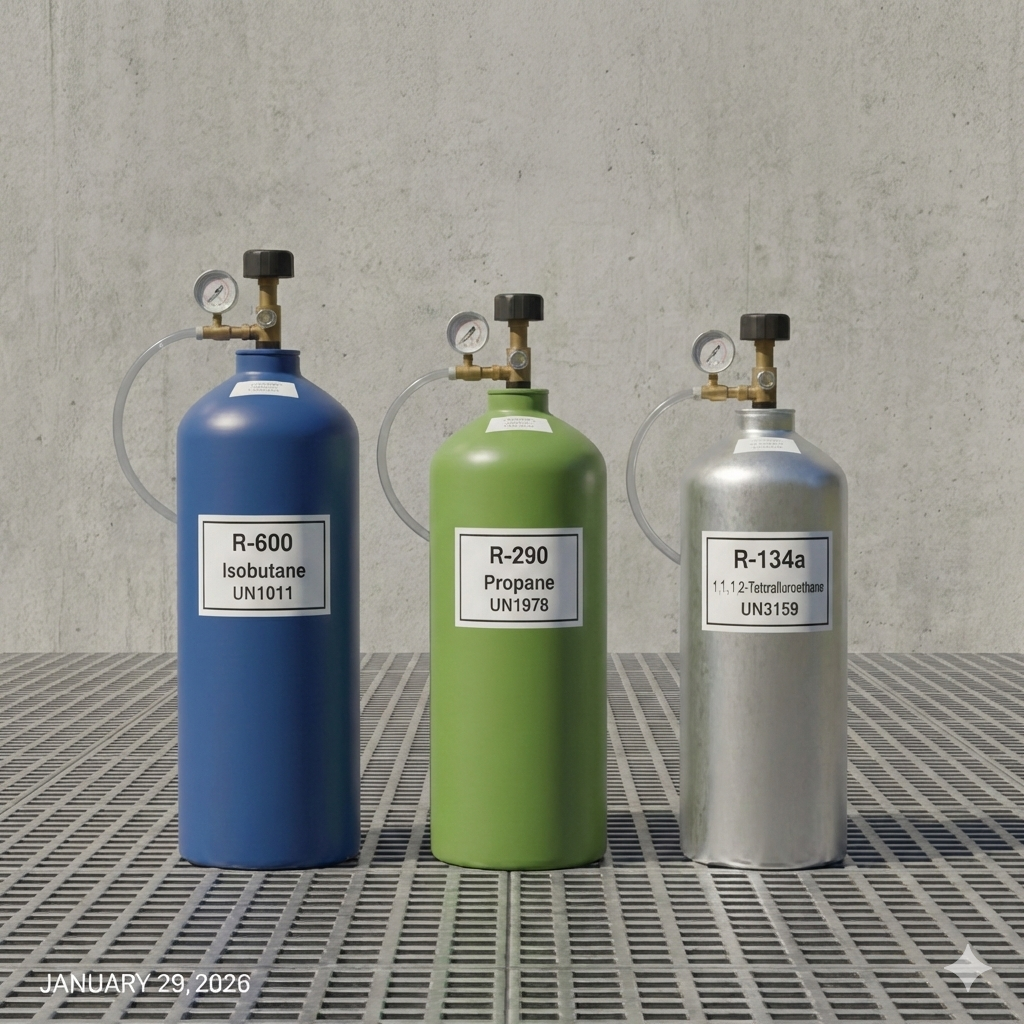
Compare R600a, R290 & R134a refrigerants. Learn the pros, cons, efficiency & environmental impact of each to choose the right refrigerant for your appliance.
R600a vs R290 vs R134a: Understanding Common Residential Refrigerants
TL;DR
The three most common refrigerants in household appliances are R134a, R600a (isobutane), and R290 (propane). R134a is the legacy synthetic option-reliable and effective in extreme temperatures but harmful to the environment. R600a dominates modern refrigerators due to its excellent efficiency and minimal environmental impact, though it struggles above 90°F. R290 offers the best performance in high-heat situations and is increasingly used in air conditioners and commercial units. Both R600a and R290 are flammable hydrocarbons, requiring proper safety certifications, while R134a is non-flammable but faces global phaseouts due to its high global warming potential.
The Short Answer: Which Refrigerant Is Best?
There's no single "best" refrigerant-each serves different needs. R134a remains common in older appliances and automotive air conditioning but is being phased out due to environmental regulations. R600a is the current standard for most household refrigerators and freezers, offering excellent efficiency in climate-controlled environments. R290 excels in high-temperature applications and is growing in popularity for air conditioners, heat pumps, and commercial refrigeration. Your ideal refrigerant depends on the appliance type, operating environment, efficiency priorities, and regional regulations. Understanding each option helps you make informed decisions when purchasing or servicing appliances.
Why Refrigerant Type Matters
The refrigerant inside your appliance directly affects its efficiency, environmental impact, performance limits, and serviceability. While most homeowners never think about refrigerant until something goes wrong, understanding the basics helps you choose appliances wisely, troubleshoot problems, and make environmentally responsible decisions.
Refrigerants work by absorbing heat when they evaporate and releasing heat when they condense. This phase-change cycle is what makes your refrigerator cold and your air conditioner cool. Different refrigerants have different thermodynamic properties, which means they perform differently under various conditions-particularly at temperature extremes.
Over the past several decades, refrigerant technology has evolved dramatically in response to environmental concerns. Early refrigerants like CFCs (chlorofluorocarbons) devastated the ozone layer. Their replacements, HFCs (hydrofluorocarbons) like R134a, protected the ozone but contributed significantly to global warming. Today's hydrocarbon refrigerants like R600a and R290 address both concerns but introduce flammability considerations. This progression explains why different refrigerants coexist in today's market and why regulations continue to evolve.
R134a: The Legacy Synthetic Refrigerant
R134a (tetrafluoroethane) has been the workhorse refrigerant for residential and automotive applications since the 1990s, when it replaced ozone-depleting R12. It remains widely used in older refrigerators, automotive air conditioning systems, and some commercial applications.
How R134a Works
R134a is a hydrofluorocarbon (HFC) that offers stable, predictable performance across a wide temperature range. Its thermodynamic properties allow it to operate efficiently from well below freezing to above 110°F ambient temperatures, making it versatile for various climates and applications.
Pros of R134a
Wide operating temperature range. R134a maintains efficiency across extreme conditions, from freezing winters to scorching summers. This makes it suitable for garage refrigerators, outdoor applications, and regions with dramatic temperature swings.
Non-flammable. Unlike hydrocarbon alternatives, R134a poses no fire or explosion risk under normal conditions. This simplifies installation requirements, reduces liability concerns, and allows use in applications where flammability would be problematic.
Established infrastructure. Decades of widespread use mean technicians are familiar with R134a systems, parts are readily available, and servicing is straightforward. Recovery and recycling programs are well-established.
Proven reliability. R134a systems have demonstrated long service lives with predictable performance, giving manufacturers and consumers confidence in the technology.
Cons of R134a
High global warming potential. R134a has a global warming potential (GWP) of 1,430-meaning one pound of R134a released into the atmosphere has the same warming effect as 1,430 pounds of carbon dioxide. This has made it a target for environmental regulations worldwide.
Regulatory phaseouts. The Kigali Amendment to the Montreal Protocol and various regional regulations are phasing down HFC production and use. The European Union has already banned R134a in new automotive applications, and restrictions continue to expand globally.
Lower efficiency than hydrocarbons. In controlled environments, R134a systems typically consume more energy than equivalent R600a or R290 systems, translating to higher operating costs and greater indirect environmental impact.
Declining availability. As phaseouts progress, R134a is becoming more expensive and harder to source. Servicing older R134a appliances may become increasingly costly.
Best Applications for R134a
R134a remains appropriate for legacy appliances still in service, applications requiring non-flammable refrigerants, and situations demanding reliable performance across extreme temperature ranges. However, new residential appliances increasingly use alternative refrigerants.
R600a: The Modern Refrigerator Standard
R600a (isobutane) has become the dominant refrigerant in household refrigerators and freezers worldwide. Its combination of excellent efficiency, minimal environmental impact, and effective cooling performance in typical residential settings has made it the industry standard for new appliances.
How R600a Works
R600a is a hydrocarbon refrigerant-essentially the same isobutane used in camping stoves and lighters, purified to refrigerant grade. Its molecular structure gives it favorable thermodynamic properties for the moderate temperature differentials required in refrigeration. The low operating pressures reduce stress on system components and improve energy efficiency.
Pros of R600a
Exceptional energy efficiency. R600a systems typically use 20-30% less energy than equivalent R134a systems. This translates directly to lower electricity bills and reduced indirect carbon emissions from power generation.
Minimal environmental impact. R600a has an ozone depletion potential of zero and a global warming potential of just 3-roughly 500 times lower than R134a. A system leak releases negligible greenhouse gases compared to synthetic alternatives.
Excellent refrigeration performance. For standard refrigerator and freezer applications in climate-controlled homes, R600a provides outstanding cooling capacity with low energy input. It excels in the 55°F-90°F ambient temperature range where most kitchen appliances operate.
Lower operating pressures. R600a systems run at lower pressures than R134a, reducing stress on compressors, seals, and tubing. This can contribute to longer component life and fewer leak points.
Quiet operation. The thermodynamic properties of R600a allow compressors to run more smoothly and quietly, a noticeable benefit in open-concept homes where kitchen noise carries.
Regulatory compliance. R600a meets current and foreseeable environmental regulations worldwide, protecting your appliance investment against future restrictions.
Cons of R600a
Flammability. As a hydrocarbon, R600a is flammable when mixed with air in concentrations between 1.8% and 8.4%. While the small charge sizes in household refrigerators (typically 2-5 ounces) minimize risk, this requires proper safety certifications and careful handling during service.
Limited high-temperature performance. R600a efficiency drops significantly when ambient temperatures exceed 90°F. Above 100°F, systems may struggle to maintain safe food storage temperatures. This makes R600a less suitable for garage refrigerators in hot climates.
Restricted charge sizes. Safety regulations limit the amount of R600a allowed in residential appliances, which can constrain cooling capacity for very large units.
Service considerations. Not all HVAC technicians are trained or equipped to work with flammable refrigerants. Finding qualified service providers may be more difficult in some areas.
Best Applications for R600a
R600a is ideal for standard household refrigerators and freezers in climate-controlled environments, compact refrigerators, wine coolers, and any application operating consistently below 90°F ambient temperature.
R290: The High-Performance Hydrocarbon
R290 (propane) is gaining momentum as a refrigerant for applications requiring strong performance in high-temperature environments. Already established in commercial refrigeration and increasingly used in residential air conditioners and heat pumps, R290 offers capabilities that complement R600a's strengths.
How R290 Works
Like R600a, R290 is a hydrocarbon refrigerant with excellent thermodynamic properties. However, R290's characteristics make it better suited for higher temperature differentials and larger cooling loads. It operates at higher pressures than R600a, enabling more aggressive heat transfer in demanding conditions.
Pros of R290
Superior high-temperature performance. R290 maintains efficiency at ambient temperatures where R600a struggles. This makes it suitable for garage refrigerators, outdoor units, and hot-climate applications up to 110°F or higher.
Outstanding energy efficiency. R290 matches or exceeds R600a's efficiency in most applications and significantly outperforms R134a. Some studies show 10-20% energy savings compared to HFC alternatives.
Minimal environmental impact. R290 shares R600a's environmental credentials-zero ozone depletion potential and a global warming potential of just 3.
Excellent heat transfer properties. R290's thermodynamic characteristics enable efficient heat exchange, reducing the size of required components and improving system responsiveness.
Versatile applications. R290 works effectively across refrigeration, air conditioning, and heat pump applications, making it a flexible choice for manufacturers and consumers.
Growing regulatory support. Environmental agencies worldwide are encouraging R290 adoption as part of HFC phasedown strategies, ensuring long-term availability and support.
Cons of R290
Higher flammability than R600a. While both are flammable, R290 has a wider flammable range (2.1%-9.5% concentration in air) and slightly lower ignition energy. This requires more stringent safety measures in design and installation.
Stricter charge limits. Regulatory limits on R290 charge sizes are conservative due to flammability concerns, which can constrain applications requiring large refrigerant volumes.
Limited residential availability. While commercial R290 applications are well-established, residential products using R290 are still expanding in the market. Selection may be more limited than R600a appliances.
Higher operating pressures. R290 runs at higher pressures than R600a, requiring more robust components and potentially increasing manufacturing costs.
Service availability. Finding technicians certified to work with R290 can be challenging, particularly in residential settings where the refrigerant is less common.
Best Applications for R290
R290 excels in garage and outdoor refrigerators, residential air conditioners and heat pumps, commercial refrigeration, and any application facing high ambient temperatures or requiring substantial cooling capacity.
Head-to-Head Comparison
Environmental Impact
| Refrigerant | Ozone Depletion Potential | Global Warming Potential |
|---|---|---|
| R134a | 0 | 1,430 |
| R600a | 0 | 3 |
| R290 | 0 | 3 |
Both hydrocarbon options dramatically outperform R134a environmentally. The difference between R600a and R290 is negligible.
Energy Efficiency
R600a and R290 both outperform R134a by significant margins in their optimal operating conditions. Between the two hydrocarbons, efficiency depends on the specific application. R600a edges ahead in moderate-temperature refrigeration, while R290 excels in high-temperature and high-capacity scenarios.
Operating Temperature Range
R134a offers the widest reliable operating range, functioning effectively from below 32°F to above 110°F ambient. R290 handles high temperatures nearly as well while offering better efficiency. R600a performs optimally between 55°F and 90°F, with degraded performance above 95°F.
Safety Considerations
R134a's non-flammability gives it a clear safety advantage in handling and installation. Both R600a and R290 require proper ventilation, certified components, and trained technicians for service. The small charge sizes in household appliances minimize actual fire risk, but the flammability classification affects transportation, storage, and installation requirements.
Cost and Availability
R134a remains widely available but is becoming more expensive as phaseouts progress. R600a is readily available and competitively priced for refrigerator applications. R290 availability in residential products is growing but currently more limited.
Choosing the Right Refrigerant for Your Needs
For Standard Kitchen Refrigerators
R600a is the clear choice for refrigerators operating in climate-controlled homes. Its efficiency, quiet operation, and environmental benefits make it ideal for typical residential use. Virtually all new refrigerators sold in Europe, Asia, and increasingly North America use R600a.
For Garage or Outdoor Refrigerators
R290 or R134a systems handle high-temperature environments more reliably than R600a. If purchasing new, look for R290 models designed for extreme conditions. Existing R134a units remain serviceable for garage use. Avoid placing R600a refrigerators in spaces that regularly exceed 90°F.
For Air Conditioners and Heat Pumps
R290 is emerging as the preferred refrigerant for new residential air conditioning and heat pump systems due to its efficiency and environmental profile. R134a remains common in existing systems but faces phaseout pressure.
For Older Appliances
If you have a functioning R134a appliance, there's no immediate need to replace it solely due to refrigerant type. Continue using it until replacement becomes necessary, then choose a modern hydrocarbon system. If service is needed, verify refrigerant availability and cost before committing to repairs.
The Future of Residential Refrigerants
The trend toward hydrocarbon refrigerants like R600a and R290 will continue accelerating as HFC regulations tighten globally. Manufacturers are investing heavily in hydrocarbon technology, improving safety features, expanding product lines, and training service networks.
Emerging technologies may eventually offer alternatives that combine the environmental benefits of hydrocarbons with the non-flammability of synthetics, but no such option has achieved commercial viability yet. For the foreseeable future, R600a will dominate household refrigeration while R290 expands in high-temperature and air conditioning applications.
When shopping for new appliances, prioritizing hydrocarbon refrigerants future-proofs your purchase against regulatory changes while delivering superior efficiency and environmental performance. Understanding the strengths and limitations of each option ensures you select the right refrigerant for your specific application and climate.
Key Takeaways
-
R134a is the legacy option-reliable across extreme temperatures and non-flammable, but environmentally harmful with a global warming potential of 1,430. It faces global phaseouts and declining availability.
-
R600a (isobutane) is the modern standard for household refrigerators, offering exceptional energy efficiency and minimal environmental impact. It performs best in climate-controlled spaces below 90°F and is unsuitable for hot garages.
-
R290 (propane) excels in high-temperature applications, maintaining efficiency where R600a struggles. It's increasingly used in air conditioners, heat pumps, and garage-rated refrigerators.
-
Both R600a and R290 are flammable, requiring proper safety certifications and trained technicians. Small residential charge sizes minimize actual fire risk.
-
Environmental impact varies dramatically-R600a and R290 have global warming potentials of just 3, compared to R134a's 1,430, making hydrocarbons the responsible choice.
-
Choose refrigerant based on application: R600a for standard kitchen refrigerators, R290 for garage units and air conditioners, and R134a only when legacy system compatibility requires it.
Understanding refrigerant differences empowers you to make smarter appliance choices that balance performance, efficiency, safety, and environmental responsibility.
Want to catch appliance problems early?
Get The Appliance Survival Kit — a simple system to spot issues before they become emergencies.
Learn More — $27