Washing machine error codes indicate specific problems with drainage, water supply, door locks, load balance, temperature, or motor function. This guide decodes the most common codes across Samsung, LG, Whirlpool, Bosch, and Hotpoint, explains DIY fixes for each category, and clarifies when professional repair is necessary.
What Those Washing Machine Error Codes Actually Mean: A Complete Homeowner's Guide
TL;DR
Washing machine error codes are your appliance's way of telling you what's wrong. Most codes fall into six categories: drainage problems, water supply issues, door lock failures, unbalanced loads, temperature faults, and motor or electrical errors. Many of these can be fixed at home in minutes with simple troubleshooting. Knowing what the codes mean can save you hundreds on unnecessary service calls.
The Short Answer: What Do Washing Machine Error Codes Mean?
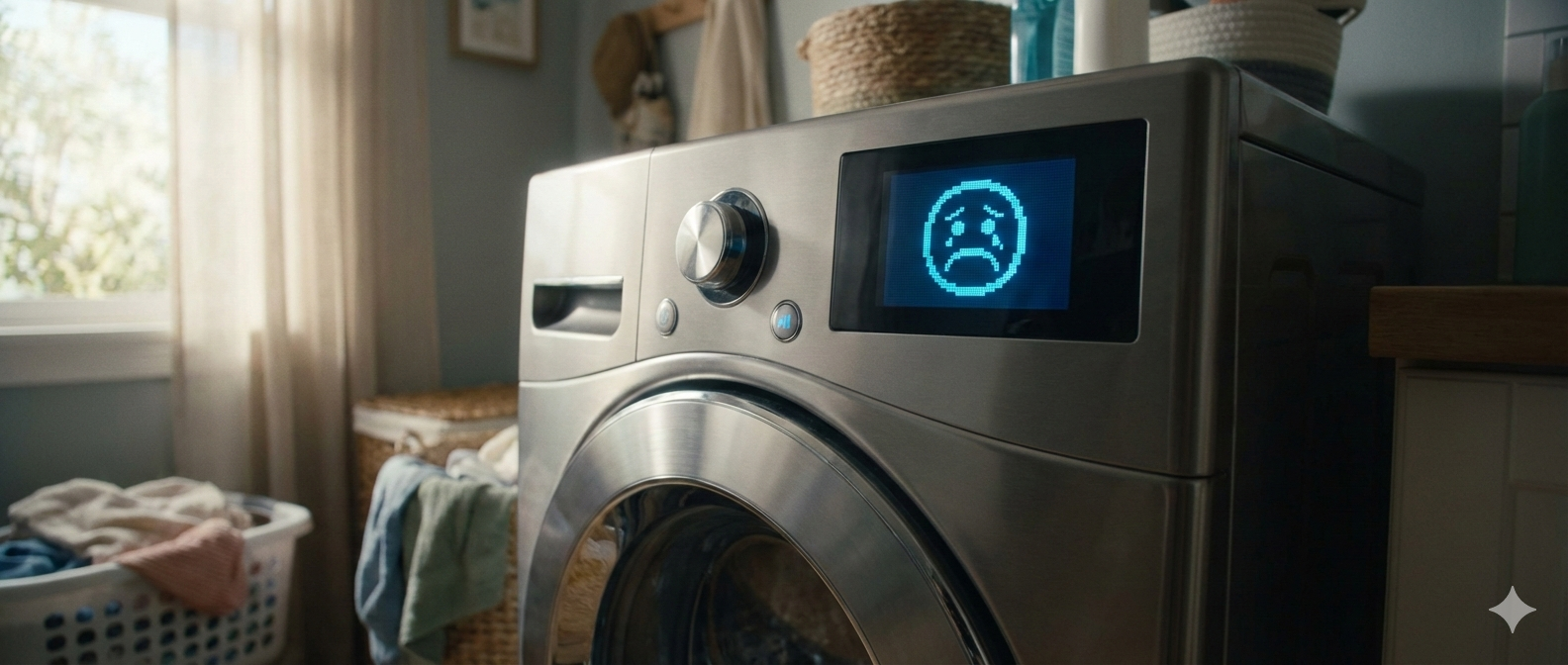
Error codes are diagnostic messages built into your washing machine's control board. When something goes wrong mid-cycle, the machine displays a combination of letters and numbers on its screen-or, on older models, blinks certain lights in a pattern-to point you toward the problem. While every brand uses its own naming system (Samsung's drainage code is "5E," while LG uses "OE" for the same issue), the underlying problems are universal. Most fall into a handful of common categories, and roughly half can be resolved without calling a technician. The key is identifying whether you're dealing with a simple blockage or user error versus a mechanical failure that needs professional attention.
How Washing Machine Error Codes Work
Before diving into specific codes, it helps to understand what's happening behind the display panel. Modern washing machines are packed with sensors-monitoring water levels, drum speed, door position, temperature, and motor performance. When a sensor reading falls outside normal range, the machine's control board halts the cycle and throws an error code.
Think of it as your washer's check-engine light. Sometimes the problem is serious, and sometimes the fix takes thirty seconds. The code itself doesn't always tell you exactly what's broken, but it narrows the search to a specific system. That's why understanding the categories matters more than memorizing every code for every brand.
It's also worth noting that a single code can have multiple causes. A drainage error might mean a clogged filter, a kinked hose, or a faulty pump. The code tells you where to look; you still need to do a bit of detective work to find the what.
The Six Most Common Error Code Categories
Drainage Errors
Drainage codes are among the most frequent washing machine errors, responsible for a significant share of service calls. These codes appear when your machine can't pump water out of the drum within the expected timeframe. On Samsung machines, you'll typically see "5E" or "5C." LG displays "OE." Whirlpool usually flashes "F21" or "F02," while Bosch uses "E18" or "F18."
The good news is that drainage problems are often the easiest to fix yourself. Start by checking the drain filter, usually located behind a small panel at the front bottom of the machine. You'd be surprised what ends up in there-coins, hair ties, bobby pins, and lint are the usual suspects. Next, inspect the drain hose behind the machine. If it's kinked, crushed against the wall, or looped too high, water simply can't escape. Straighten the hose and make sure it's not pushed too far into the standpipe, which can create an air lock.
If the filter and hose both look fine, the drain pump itself may be failing. You might hear a humming sound when the machine tries to drain, which suggests the pump is getting power but can't move water. That's when it's time to call a technician.
Water Supply and Inlet Errors
These codes trigger when the washing machine isn't filling with water fast enough-or at all. LG uses "IE" for inlet errors, Samsung shows "4C" or "4E," and Whirlpool typically displays "F8 E1." On most machines, the code will appear within the first few minutes of a cycle because the drum isn't reaching the expected water level.
The fix is usually straightforward. First, confirm that the water supply taps behind the machine are fully open. It sounds obvious, but taps get bumped and partially closed more often than you'd think. Then check the inlet hoses for kinks. Finally, examine the small mesh filters where the hoses connect to the machine-these catch sediment and mineral buildup over time and can restrict flow. A quick rinse under the tap usually clears them.
If the taps are open, the hoses are clear, and the filters are clean, the water inlet valve inside the machine may be faulty. That's a relatively affordable part, but installation typically requires a professional.
Door Lock Errors
Your washing machine won't start a cycle if it doesn't detect that the door is securely locked, and it won't unlock during a cycle if it senses something is wrong. Codes like "dE" (Samsung and LG), "dL" (Whirlpool), "F01" (some Hotpoint models), and "E3" (various brands) all point to door lock issues.
Sometimes the fix is embarrassingly simple: a sock or piece of fabric caught in the rubber door seal can prevent the door from closing completely. Open the door, check the seal, remove any obstructions, and close the door firmly until you hear or feel the lock engage.
If the door appears to close properly but the code persists, the problem likely lies with either the door latch mechanism or the electronic lock sensor. These are wear-and-tear parts that degrade over time, especially on machines that get heavy daily use. Replacing a door lock assembly is a moderately involved repair but well within the range of an experienced DIYer with the right replacement part.
Unbalanced Load Errors
Unbalanced load codes-"UE" or "UB" on LG, "dc" or "Ur" on Samsung, and "UL" on Whirlpool-are among the most common and least alarming errors you'll encounter. These appear during the spin cycle when the drum's contents have shifted to one side, creating excessive vibration.
Heavy items like blankets, comforters, and bath mats are the usual culprits. When a large item clumps against one side of the drum, the machine detects the imbalance and either slows down, pauses, or stops entirely to prevent damage to the bearings and suspension.
The fix takes about fifteen seconds: pause the cycle, open the door, and redistribute the laundry more evenly around the drum. For smaller loads, consider tossing in a couple of towels to give the drum enough mass to spin smoothly. If you keep getting this error with normal-sized loads, make sure the machine itself is level-uneven feet can amplify the problem. Place a spirit level on top of the machine and adjust the legs as needed.
Temperature and Heating Errors
Temperature error codes such as "HE," "E5," "F03," and "tE" indicate the water isn't reaching the correct temperature. This is especially common in front-loading machines that heat their own water rather than drawing it from a hot water line.
These errors can stem from a few sources. A faulty heating element is the most common cause-over time, mineral deposits from hard water can coat the element and reduce its efficiency until it fails entirely. A malfunctioning NTC thermistor (the sensor that tells the control board what the water temperature is) can also trigger the code, even if the element is working fine. Less commonly, a wiring issue between the sensor and the control board can cause intermittent temperature faults.
Temperature errors generally do require professional diagnosis, since the heating element and thermistor are internal components. However, before scheduling service, check whether you've selected the correct temperature for your cycle. Accidentally choosing cold wash on a cycle that expects warm water can sometimes trigger a false alarm on certain models.
Motor and Electrical Errors
Motor codes-"3E" or "E3" on Samsung, "LE" on LG, "F06" on Whirlpool, and "F01" on Hotpoint (main control board fault)-are the most serious category. These errors relate to the motor that spins the drum, the control board that orchestrates everything, or the communication between the two.
Unlike a clogged filter or kinked hose, motor and electrical problems almost always require a trained technician. The one exception is a simple power reset: unplug the machine for sixty seconds, then plug it back in and try the cycle again. Electrical glitches can occasionally cause a false motor error, and the reset clears the control board's memory. If the code returns after a reset, don't keep running the machine-continued use could cause further damage.
Quick-Reference Error Codes by Brand
| Problem | Samsung | LG | Whirlpool | Bosch | Hotpoint |
|---|---|---|---|---|---|
| Drainage | 5E, 5C | OE | F21, F02 | E18, F18 | F05, F11 |
| Water supply | 4C, 4E | IE | F8 E1 | E17, F17 | F03 |
| Door lock | dE, dL | dE | dL, F5 E1 | E16, F16 | F01 |
| Unbalanced load | dc, UB, Ur | UE | UL | E4 | - |
| Temperature | HE, tE | tE | - | E5 | F03, F08 |
| Motor / electrical | 3E, E3 | LE | F06 | E9, F09 | F01, F02 |
| Excess suds | Sud, Sd | Sud | Sud, Sd | - | - |
Note: Codes vary by model even within the same brand. Always check your owner's manual for model-specific codes.
When to DIY vs. When to Call a Professional
Not every error code justifies a service call, but some absolutely do. Here's how to decide.
Handle it yourself if you're dealing with a drainage error (check the filter and hoses first), a water supply code (verify taps, hoses, and inlet filters), an unbalanced load (redistribute the laundry), or a door lock alert caused by an obstruction in the seal. These are the most common scenarios, and most can be resolved in under ten minutes.
Call a professional if you see a motor or electrical error that persists after a power reset, a temperature code that keeps coming back, a door lock error with no visible obstruction, or any code that your owner's manual flags as requiring service. Repeated drainage errors after cleaning the filter could also indicate a failing pump that needs replacement.
A good rule of thumb: if you've tried two rounds of basic troubleshooting and the code keeps returning, it's time to get an expert involved. Continuing to run a machine that's throwing persistent errors can turn a minor repair into a major one.
Preventing Error Codes Before They Happen
Most washing machine errors are preventable with a little routine maintenance. Clean the drain filter once a month-or more often if you have pets or wash heavily soiled items regularly. Inspect the inlet hose filters every few months for sediment buildup. Avoid overloading the drum; a good rule is to fill it no more than three-quarters full to allow proper agitation and spinning.
Detergent matters too. High-efficiency (HE) machines are especially sensitive to soap quantities. Using too much detergent-or the wrong type-creates excess suds, which can trigger "Sud" error codes and leave residue that clogs internal components over time. Follow the manufacturer's recommendation, and when in doubt, use slightly less rather than more.
Finally, leave the door ajar after each wash to let the drum and seal air dry. This prevents mold and mildew growth inside the rubber gasket, which can eventually interfere with the door seal and trigger lock errors.
Key Takeaways
-
Error codes are diagnostic tools, not death sentences. They narrow down the problem area so you know where to start troubleshooting rather than guessing blindly.
-
Six categories cover nearly all codes. Drainage, water supply, door lock, unbalanced load, temperature, and motor/electrical issues account for the vast majority of errors across all brands.
-
About half of common errors are DIY-fixable. Clogged filters, kinked hoses, unbalanced loads, and door obstructions are all things you can handle at home in minutes.
-
Always try a power reset. Unplugging the machine for sixty seconds clears the control board and resolves intermittent glitches more often than you'd expect.
-
Your owner's manual is your best friend. Codes vary between brands and even between models within the same brand, so the manual is the definitive source for your specific machine.
-
Don't ignore persistent codes. If an error returns after basic troubleshooting, continuing to run the machine risks turning a small fix into an expensive repair.
-
Prevention is easier than repair. Monthly filter cleaning, proper detergent use, and balanced loads will keep most error codes from ever appearing.
Want to catch appliance problems early?
Get The Appliance Survival Kit — a simple system to spot issues before they become emergencies.
Learn More — $27